


Rupert Neve Designs 551 Inductor EQ Plug-In
The Rupert Neve Designs 551 Inductor EQ Plug-In brings the character of the acclaimed 551 500 Series hardware equaliser into the DAW. Based on the EQ circuit originally developed for the flagship Shelford Channel, the plug-in models the custom-wound inductors, transformers and Class A gain stages that give the hardware its distinctive analogue character.
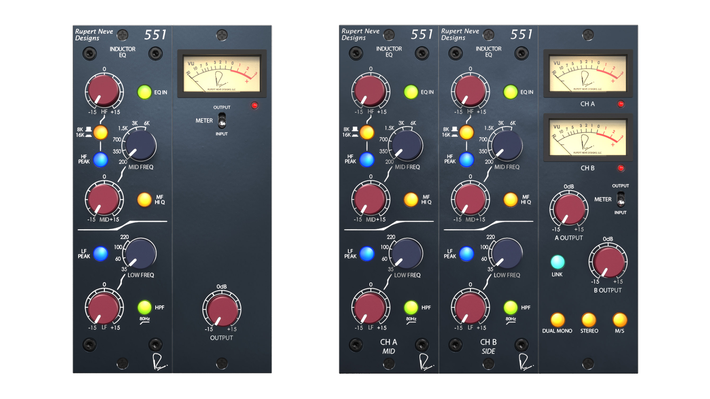
The 551 combines three bands of musical equalisation with flexible Peak and Shelf operation, a fixed 80 Hz high-pass filter, selectable Mid Q and dedicated mono, stereo, dual mono and Mid/Side processing.
Designed for tracking, mixing, mastering and live sound, the 551 can be used for subtle tonal shaping or much stronger EQ moves while retaining the harmonic character associated with Rupert Neve Designs analogue circuitry.
Faithful Recreation of the 551 Hardware EQ
The 551 Inductor EQ Plug-In is modelled after the Rupert Neve Designs 551 500 Series hardware module introduced in 2014.
The original 551 was itself derived from the inductor EQ section developed for the Shelford Channel and the penthouse modules of the 5088 console.
Rather than simply reproducing the EQ curves, Rupert Neve Designs modelled the behaviour of the custom inductors, transformers and Class A circuitry used in the hardware. This includes the harmonic interaction between the analogue components and the individual EQ settings.
The result is a software EQ designed to recreate both the frequency shaping and analogue character of the original hardware.
Three-Band Inductor EQ
The Rupert Neve Designs 551 provides three independently adjustable EQ bands covering low, mid and high frequencies.
Each band draws inspiration from different elements of Rupert Neve's classic analogue EQ designs while adding additional flexibility for modern recording and mixing.
All three EQ bands provide up to ±15 dB of boost or cut.
Low Frequency EQ
The low-frequency section is inspired by the character of the vintage 1064 EQ.
Four selectable frequencies are available:
-
35 Hz
-
60 Hz
-
100 Hz
-
220 Hz
The LF band can operate as either a shelving or peak filter.
In Shelf mode, the circuit provides broad low-frequency shaping. Engaging LF PEAK changes the band to a bell-shaped response for more focused low-frequency adjustment.
The low band is designed to provide the rich and resonant bass response associated with classic inductor-based equalisation while retaining additional flexibility compared with the original vintage designs.
1073-Inspired Midrange EQ
The Mid band takes inspiration from Rupert Neve's classic 1073 equaliser.
Six selectable centre frequencies are provided:
-
200 Hz
-
350 Hz
-
700 Hz
-
1.5 kHz
-
3 kHz
-
6 kHz
The Mid control provides up to ±15 dB of boost or cut.
A dedicated MF HI Q switch narrows the proportional Q of the Mid band, allowing the 551 to move between broader musical tonal shaping and more focused EQ adjustments.
This makes the Mid section suitable for both corrective work and for bringing vocals, instruments and other mix elements forward.
Flexible High Frequency EQ
The high-frequency section combines vintage-inspired inductor behaviour with a more modern circuit approach.
Two selectable frequencies are provided:
-
8 kHz
-
16 kHz
As with the low band, the high-frequency section can operate in either Shelf or Peak mode.
With HF PEAK disengaged, the EQ operates as a shelving filter. Engaging HF PEAK changes the response to a bell-shaped curve for more targeted high-frequency processing.
The HF band provides up to ±15 dB of boost or cut.
80 Hz High-Pass Filter
The 551 includes a fixed 80 Hz high-pass filter with a 12 dB per octave slope.
The high-pass filter operates independently of the three main EQ bands and can be used together with the low-frequency section.
This makes it possible to remove unwanted sub frequencies while simultaneously adding weight or presence at a selected low-frequency EQ point.
Mono, Stereo, Dual Mono and Mid/Side Processing
The 551 Inductor EQ Plug-In includes separate interfaces for mono and two-channel operation.
The two-channel version provides three processing modes:
Dual Mono allows Channel A and Channel B to be adjusted independently.
Stereo applies the Channel A controls to both channels for conventional linked stereo processing.
M/S assigns Channel A to the Mid signal and Channel B to the Side signal, allowing the centre and stereo information of a mix to be equalised independently.
Mid/Side operation is particularly useful for stereo buses and mastering applications where different EQ settings are required for the centre and sides of a mix.
Channel Linking
The two-channel version also includes a LINK function.
When LINK is engaged, the EQ controls of both channels move together while maintaining existing relative offsets where applicable.
This can be used in Dual Mono, Stereo and Mid/Side processing modes.
Input and Output Metering
The plug-in includes VU-style level meters that can display either the input or output signal level.
A clipping indicator provides visual feedback when the selected stage approaches the plug-in's clipping point.
Independent Output Trim controls provide up to ±15 dB of level adjustment, making it easier to compensate for level changes created by EQ boosts or cuts.
For Tracking, Mixing and Mastering
The Rupert Neve Designs 551 is designed to work across individual tracks, buses and complete mixes.
Its combination of broad musical EQ curves, selectable Peak and Shelf operation and analogue component modelling makes it suitable for sources including vocals, guitars, drums and instruments as well as stereo buses and mastering applications.
The plug-in can be used for subtle tonal adjustments or considerably stronger EQ moves while retaining the harmonic behaviour modelled from the original 551 hardware.
Key Features
-
Official Rupert Neve Designs 551 Inductor EQ Plug-In
-
Faithful recreation of the 551 500 Series hardware EQ
-
EQ architecture originally developed for the Shelford Channel
-
Models custom-wound inductors
-
Models transformers and Class A gain stages
-
Three-band EQ
-
±15 dB boost and cut per EQ band
-
LF frequencies: 35 Hz, 60 Hz, 100 Hz and 220 Hz
-
LF Shelf and Peak operation
-
Mid frequencies: 200 Hz, 350 Hz, 700 Hz, 1.5 kHz, 3 kHz and 6 kHz
-
1073-inspired Mid EQ character
-
Switchable MF HI Q
-
HF frequencies: 8 kHz and 16 kHz
-
HF Shelf and Peak operation
-
Fixed 80 Hz high-pass filter
-
12 dB/octave high-pass filter slope
-
Mono plug-in version
-
Two-channel plug-in version
-
Dual Mono processing
-
Stereo processing
-
True Mid/Side processing
-
Channel Link function
-
Input and output metering
-
±15 dB Output Trim
-
Suitable for tracking, mixing, mastering and live sound
Plug-In Formats and Compatibility
Plug-in formats: AAX Native, AU and VST3
Compatible DAWs include: Pro Tools, Logic Pro, Cubase, Nuendo, FL Studio, Ableton Live, LUNA, Reaper, Sonar and Studio One, plus other hosts supporting the compatible plug-in formats.
Processor support: Intel and Apple silicon
macOS: 10.13 High Sierra through macOS 15 Sequoia and macOS 26 Tahoe
Windows: Windows 10 and Windows 11
License and Authorization
An iLok account is required.
Authorization can be stored using:
-
iLok 2 USB Smart Key
-
iLok 3 USB Smart Key
-
Local machine authorization
-
iLok Cloud session
Each purchased Rupert Neve Designs plug-in license includes two activations.
A physical iLok USB key is therefore not necessarily required when using machine authorization or iLok Cloud.