
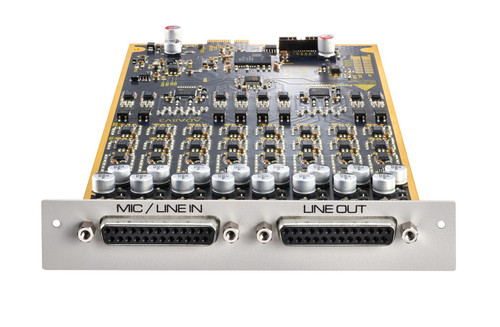



Neumann ADA8V3S
The Neumann ADA8V3S is an eight-channel mic and line input and output card for the Merging Hapi Mk III audio mainframe. It combines eight remote-controlled microphone and line inputs with eight line outputs, providing analogue-to-digital and digital-to-analogue conversion within a single expansion card.
Based on third-generation Dual Gain topology inspired by the Anubis preamps, the ADA8V3S is designed for transparent recording, high dynamic range and precise remote control. It supports sample rates up to 192 kHz and connects analogue equipment through two 25-pin Sub-D connectors using the AES59 Tascam analogue pinout.
Two ADA8V3S cards can be installed in a Hapi Mk III to create a system with up to 16 analogue input and output channels.
Eight Transparent Mic and Line Inputs
The ADA8V3S provides eight microphone and line inputs with software-controlled gain and individually switchable input functions.
Each microphone preamp offers a standard gain range from 0 dB to +66 dB, with up to 78 dB of total gain available when Boost is used.
Per-channel controls include:
-
+48V phantom power
-
Polarity inversion
-
80 Hz low-cut filter
-
Switchable input impedance
-
Microphone or line-level operation
Each channel can be switched to line input mode locally using the Hapi Mk III display or controlled remotely through a browser-based interface.
Third-Generation Dual Gain Topology
The ADA8V3S uses third-generation Dual Gain technology inspired by the microphone preamps developed for the Merging Anubis.
The microphone input section provides a typical A-weighted dynamic range of 137 dB, while microphone Boost mode provides a typical A-weighted dynamic range of 128 dB.
The dedicated line inputs provide a typical A-weighted dynamic range of 139 dB referenced to +24 dBu.
This architecture allows the ADA8V3S to accommodate low-level microphone signals and professional line-level sources while maintaining low noise and distortion.
Eight Line Outputs
Eight line outputs provide digital-to-analogue conversion for monitoring, analogue processing, summing and external studio equipment.
The maximum output level can be switched through software between +24 dBu and +18 dBu at 0 dBFS.
Digitally controlled output trims support system alignment and line-up procedures, while automatic muting circuitry helps prevent unwanted pops when the system is powered on or off.
The line outputs provide a typical A-weighted dynamic range of up to 124 dB and THD+N below -117 dB at 0 dBFS.
Remote Control and System Integration
All ADA8V3S input and output parameters can be controlled remotely.
Microphone gain, phantom power, polarity, low-cut filtering, impedance, input mode and output trim settings can be adjusted through the Hapi Mk III interface or remotely using a compatible browser.
This allows the card to be integrated into recording, broadcast and installed audio systems where centralised control and repeatable configuration are required.
Sample Rates up to 192 kHz
The Neumann ADA8V3S supports sample rates up to 192 kHz.
Its frequency response adapts to the selected sample rate:
-
9 Hz to 22 kHz at 48 kHz
-
9 Hz to 46 kHz at 96 kHz
-
11 Hz to 94 kHz at 192 kHz
Input latency remains eight samples at supported sample rates. Output latency is nine samples using the Slow Roll Off filter or 38 samples using the Sharp Roll Off filter.
Key Features
-
Eight-channel mic and line input card
-
Eight-channel line output card
-
A/D and D/A conversion
-
Designed for the Merging Hapi Mk III
-
Third-generation Dual Gain topology
-
Eight transparent, Swiss-designed microphone preamps
-
Up to 78 dB microphone gain with Boost
-
139 dB A-weighted dynamic range on line inputs
-
Up to 124 dB A-weighted dynamic range on line outputs
-
Sample rates up to 192 kHz
-
Remote control of all parameters
-
Per-channel microphone or line input selection
-
Per-channel +48V phantom power
-
Per-channel polarity inversion
-
Per-channel switchable input impedance
-
Per-channel 80 Hz low-cut filter
-
Digitally controlled output trims
-
Switchable +24 dBu or +18 dBu maximum output level
-
Automatic mute circuitry for pop-free power cycling
-
Two 25-pin Sub-D connectors
-
AES59 Tascam analogue connector pinout
-
Two cards support up to 16 analogue inputs and outputs
Technical Specifications
Microphone Preamp and A/D Section
Maximum microphone input:
+24 dBu with Mic + Pad
+12 dBu in Mic mode
0 dBu in Mic Boost mode
Input impedance: 3 kΩ or 10.4 kΩ, software switchable per channel
Gain range: 0 dB to +66 dB, software controlled
Maximum gain with Boost: 78 dB
Dynamic range: 137 dB A-weighted, typical, referenced to +12 dBu
Dynamic range in Mic Boost: 128 dB A-weighted, typical, referenced to 0 dBu
THD+N, preamp and A/D: < -111 dB / 0.00028% at -2 dBFS
Interchannel crosstalk at 1 kHz: < -130 dB
Equivalent input noise: < -127 dBu at more than 40 dB gain
Common-mode rejection: >75 dB from 20 Hz to 20 kHz
Phantom power: +48V, software switchable per channel
Polarity inversion: Software switchable per channel
Low-cut filter: 80 Hz, 12 dB per octave
Line Input Section
Maximum line input for 0 dBFS: +24 dBu
Input impedance: 10.4 kΩ differential
Dynamic range: 139 dB A-weighted, typical, referenced to +24 dBu
THD+N, line input and A/D: < -111 dB / 0.00028% at -2 dBFS
Interchannel crosstalk at 1 kHz: < -135 dB, typical
Sensitivity range for 0 dBFS: -42 dBu to +24 dBu
Gain step: 0.5 dB
Common-mode rejection: >75 dB from 20 Hz to 20 kHz
Connector: DB-25, AES59 Tascam analogue pinout
Line Output Section
Maximum output level at 0 dBFS: +24 dBu or +18 dBu, software switchable
Output impedance: <80 Ω differential
Dynamic range: 122 dB or 124 dB A-weighted, typical
THD+N at 1 kHz and 0 dBFS: < -117 dB / 0.00014%
Interchannel crosstalk at 1 kHz: < -139 dB
Connector: DB-25, AES59 Tascam analogue pinout
Frequency Response
At 48 kHz: 9 Hz to 22 kHz, +0/-0.3 dB
At 96 kHz: 9 Hz to 46 kHz, +0/-0.3 dB
At 192 kHz: 11 Hz to 94 kHz, +0/-0.3 dB
Latency
Input latency: 8 samples at 44.1 to 192 kHz
Output latency, Slow Roll Off filter: 9 samples
Output latency, Sharp Roll Off filter: 38 samples
Compatibility
The ADA8V3S is designed for installation in the Merging Hapi Mk III audio mainframe.
Connections
-
2 × 25-pin Sub-D connectors
-
AES59 Tascam analogue pinout
-
8 × microphone or line inputs
-
8 × line outputs


