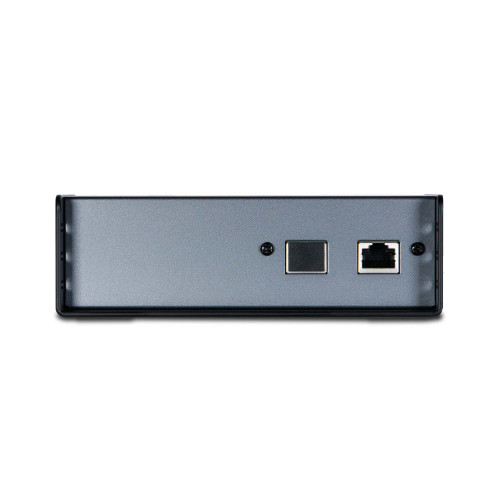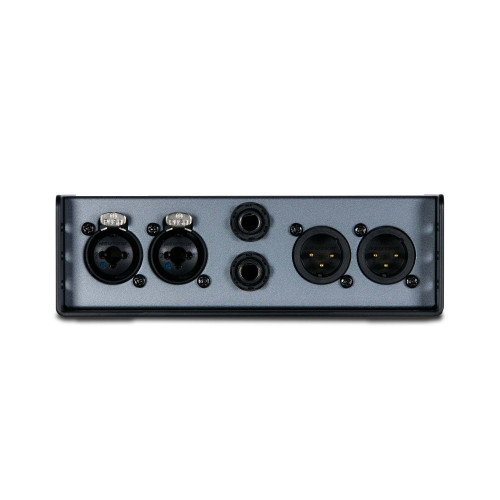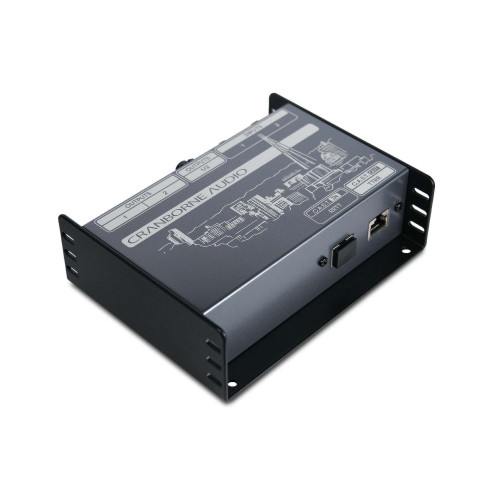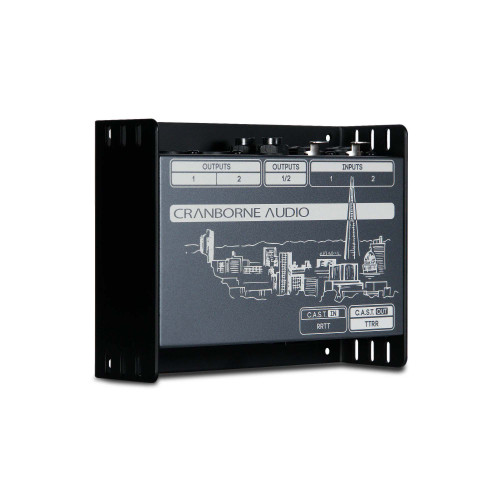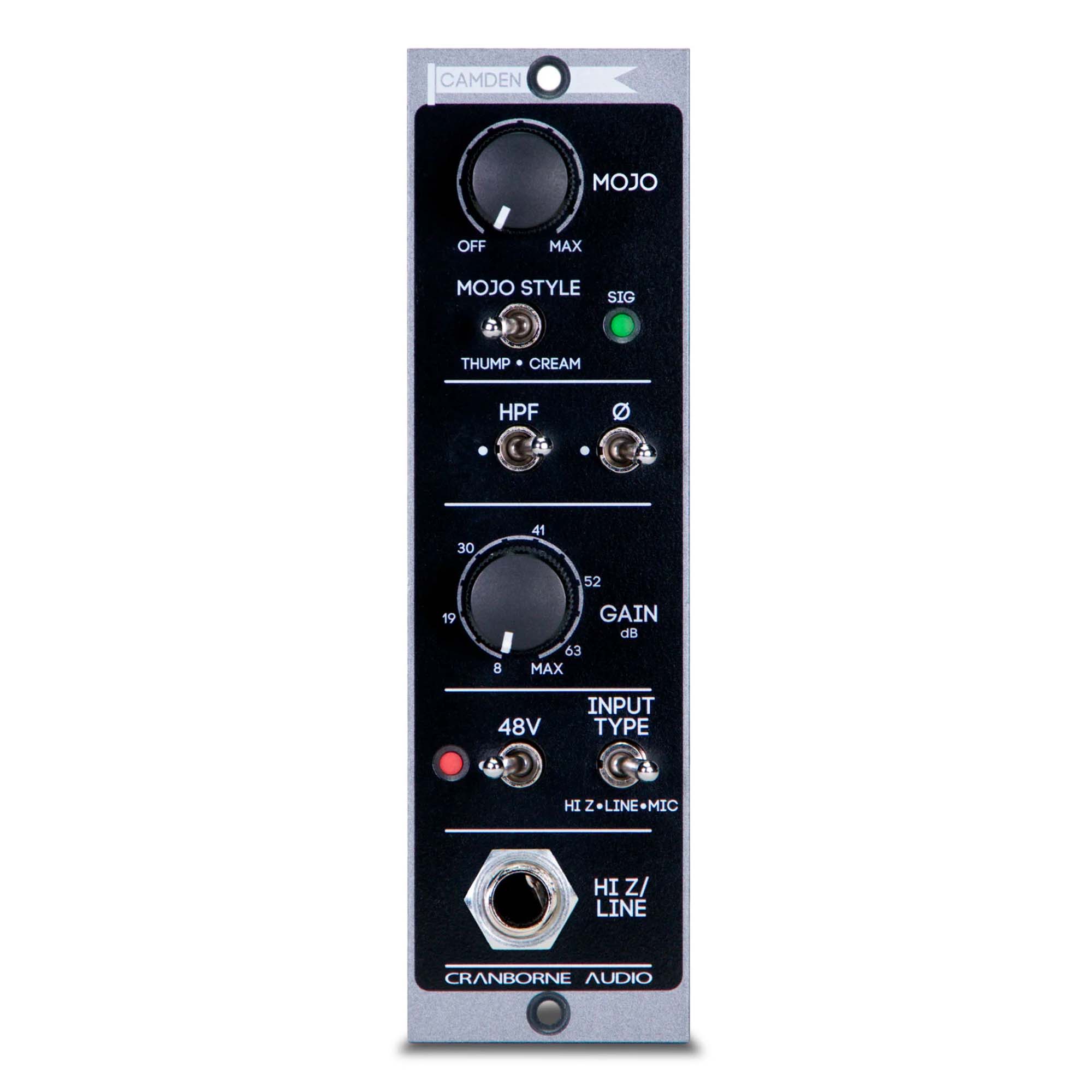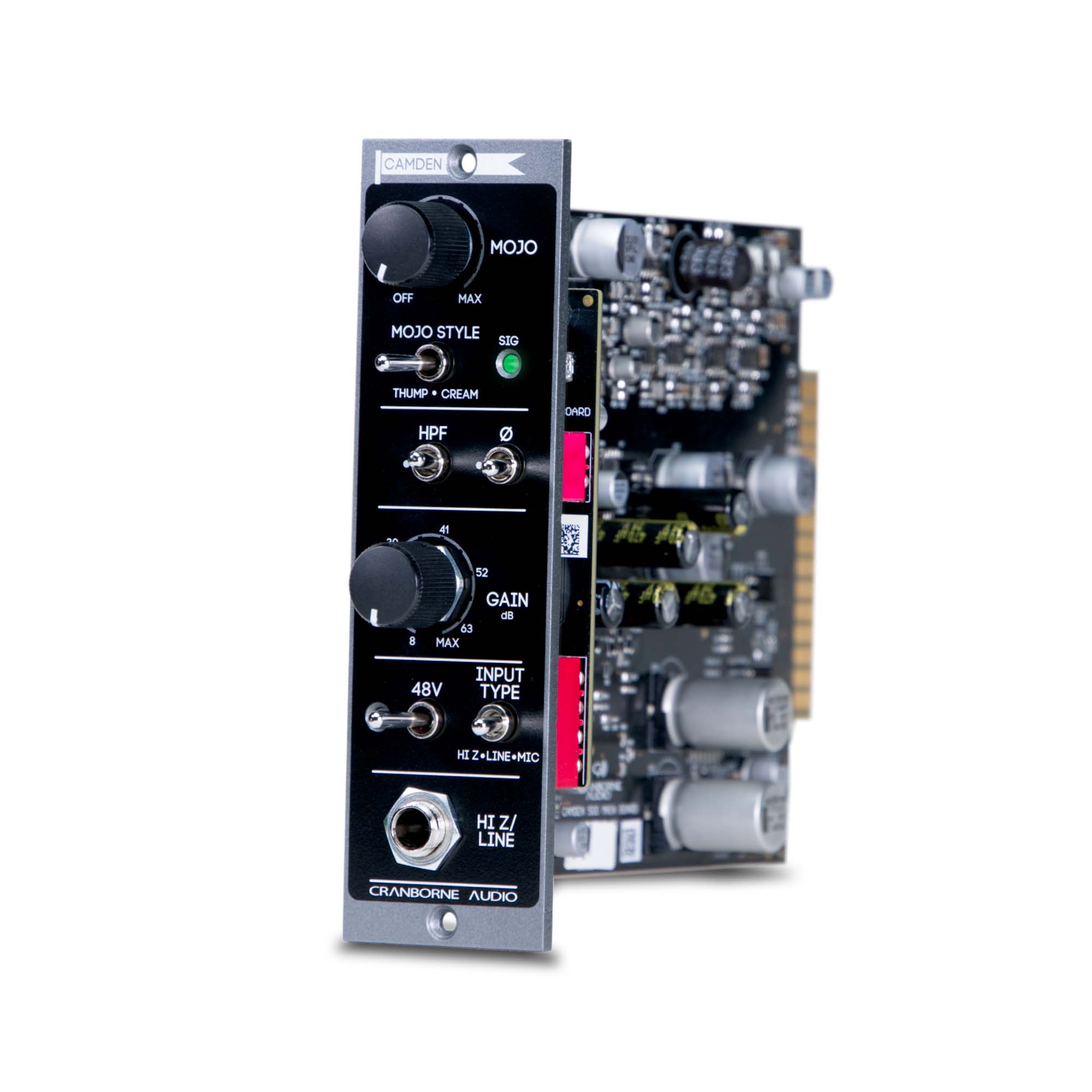



Cranborne Audio Camden 500
The Cranborne Audio Camden 500 is a fully discrete, transformerless 500 Series microphone preamp and analogue signal processor featuring Cranborne Audio's custom Camden preamp topology and variable Mojo saturation.
Designed specifically for the 500 Series format, Camden 500 combines exceptionally clean, transparent amplification with two switchable analogue saturation styles, THUMP and CREAM. With mic, line and Hi-Z inputs, up to 68 dB of microphone gain and a wide frequency response, it can operate as a transparent recording preamp, instrument DI or line-level analogue saturation processor.
Clean, Transparent Camden Preamp
At the heart of the Camden 500 is Cranborne Audio's custom transformerless preamp topology.
With Mojo bypassed, the circuit is designed to operate close to the theoretical limits of noise, distortion and frequency and phase linearity. Equivalent input noise is below -129.5 dBu with a 150 ohm source, while THD+N is below 0.0004% at 1 kHz, 35 dB gain and +24 dBu output.
Its frequency response extends from below 5 Hz to beyond 200 kHz across all gain settings, providing transparent amplification across the audio spectrum.
Mic, Line and Hi-Z Inputs
Camden 500 provides dedicated operating modes for microphone, line-level and Hi-Z instrument sources, with optimised impedance and headroom for each input type.
The microphone input provides up to 68 dB of gain, while the line input offers up to 60 dB and the Hi-Z input up to 63 dB.
With up to +26.5 dBu of line input headroom and a 1.5 MOhm unbalanced Hi-Z input impedance, Camden 500 can accommodate microphones, instruments, synthesisers and other line-level studio equipment.
12-Way Stepped Gain Control
A 12-position stepped gain control provides repeatable gain settings in 5.5 dB increments.
The stepped design makes settings easy to recall and allows two Camden 500 modules to be configured accurately for stereo recording.
Cranborne Audio states that Camden preamps are stereo matched to within 0.1 dB, with every preamp undergoing frequency-response testing at the factory.
Mojo Analogue Saturation
When additional analogue character is required, Camden 500's variable Mojo circuit provides two distinct saturation styles.
Unlike transformers or valves that form a permanent part of a preamp's signal path, Mojo can be progressively increased, adjusted to taste or completely bypassed.
This gives Camden 500 three distinct operating characters: transparent Camden amplification, THUMP saturation and CREAM saturation.
THUMP
THUMP is designed to excite low-frequency content by introducing additional harmonics.
The effect is generated through harmonic saturation rather than conventional EQ, so the resulting character responds to the existing low-frequency content of the source.
Cranborne Audio describes THUMP as boosting lower odd and even harmonics from approximately 160 Hz down to 20 Hz and below.
CREAM
CREAM provides a different saturation response inspired by the behaviour associated with valves, tubes and vintage equipment.
It increases odd and even harmonic content while dynamically smoothing the low-mid frequencies for greater high-frequency emphasis.
The effect changes dynamically according to the input level and source material.
Use Mojo During Recording or Mixing
Camden 500 is not limited to microphone recording.
Line-level material from a DAW can be routed through the Camden 500 and processed with Mojo, allowing analogue saturation to be applied to recorded tracks, stems, virtual instruments and mixes.
With Mojo bypassed, the same line input provides clean and transparent line-level amplification.
Progressive-Slope High-Pass Filter
Camden 500 includes an 80 Hz high-pass filter with a progressive slope.
The filter begins with a gentler roll-off before increasing towards 12 dB per octave at the lowest frequencies, helping remove unwanted low-frequency information while retaining more of the desired low end.
Key Features
-
Fully discrete, transformerless microphone preamp
-
Custom Cranborne Audio Camden preamp topology
-
Designed specifically for the 500 Series format
-
Mic, line and Hi-Z input modes
-
Up to 68 dB microphone gain
-
Up to 60 dB line gain
-
Up to 63 dB Hi-Z gain
-
12-position stepped gain control
-
5.5 dB gain increments
-
Extremely low noise and distortion
-
Wide frequency response
-
Variable Mojo analogue saturation
-
THUMP saturation mode
-
CREAM saturation mode
-
True bypass for Mojo processing
-
Suitable for line-level analogue saturation
-
80 Hz progressive-slope high-pass filter
-
Stereo matching within 0.1 dB
-
Gold-flashed backplane contacts
-
Designed and engineered in the United Kingdom
Technical Specifications
Minimum Gain: Mic 8 dB, Line 0 dB, Hi-Z 3 dB
Maximum Gain: Mic 68 dB, Line 60 dB, Hi-Z 63 dB
Mic Input Impedance: 8.9 kOhms with 48V off, 5.4 kOhms with 48V on
Line Input Impedance: 24.3 kOhms
Hi-Z Input Impedance: 1.5 MOhm unbalanced, 3 MOhm balanced
Maximum Mic Input Level: +17.6 dBu at <0.003% THD
Maximum Line Input Level: +26.5 dBu at <0.02% THD
Maximum Hi-Z Input Level: +24 dBu at <0.02% THD
Maximum Output Level: +27.5 dBu at <0.002% THD, 30 dB gain
Output Impedance: 150 ohms
Equivalent Input Noise: < -129.5 dBu, 150 ohm source, unweighted
THD+N: <0.0004% at 1 kHz, 35 dB gain, +24 dBu output
Intermodulation Distortion: <0.0008% at 50 Hz and 7 kHz, 35 dB gain, +20 dBu output
Frequency Response: ±0.25 dB, <5 Hz to >200 kHz at 35 dB gain
Phase Shift: <2.25° at 40 dB gain, 20 Hz to 20 kHz
CMRR: >70 dB, typically >85 dB
Slew Rate: 20 V/µs
High-Pass Filter: 80 Hz, -3 dB, 12 dB/octave
Current Draw: 120 mA per rail idle, 140 mA per rail typical
Dimensions: 31.8 × 133.35 × 170.11 mm