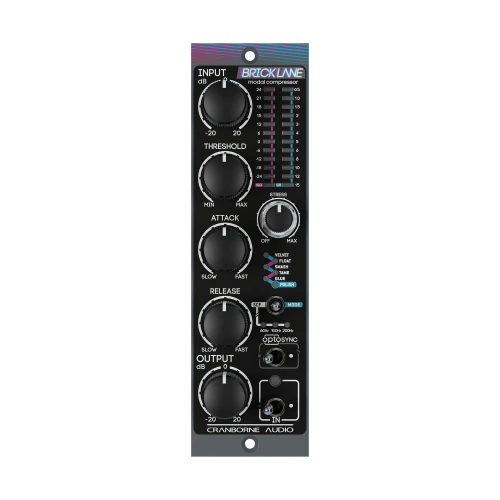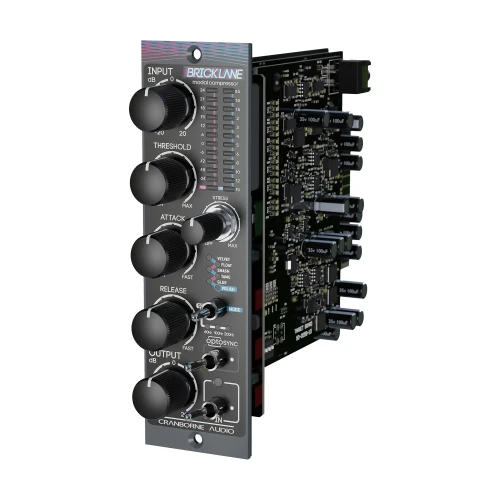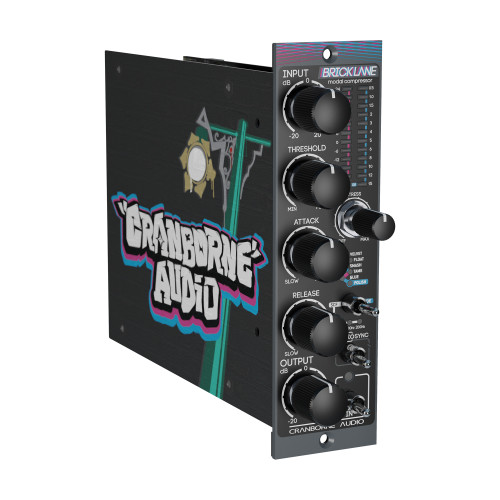



Cranborne Audio Brick Lane MC4
The Cranborne Audio Brick Lane MC4 is a 4-channel Modal PWM dynamics processor combining analogue compression, gating, harmonic saturation and flexible routing within a digitally controlled, recallable 2U rackmount platform.
Developed from Cranborne Audio's Brick Lane 500 Modal PWM Compressor, the Brick Lane MC4 provides four channels of pure analogue Pulse Width Modulation dynamics processing with no digital conversion in the audio signal path. Its flexible architecture supports Mono, Stereo, Mid/Side, Series, Dual-Band and De-Esser operation, allowing the four dynamics channels to be configured for a wide range of tracking, mixing and mastering applications.
Six Modal PWM Compression Modes
Each Brick Lane MC4 channel uses Cranborne Audio's Modal PWM compression architecture. Rather than simply changing conventional ratio and threshold settings, the six modes alter compression behaviour, envelope characteristics and harmonic response.
The six available compression modes are:
VELVET delivers vintage Vari-Mu-style musicality with tube-inspired harmonic compression for smooth dynamic control, warmth and character.
FLOAT provides Opto-inspired dynamics with gentle, wave-like compression ballistics.
SMASH offers FET-style transient control with aggressive gain reduction, punch and impact.
TAME is designed for ultra-fast, transparent transient management and precise dynamics control.
GLUE provides gentle bus-style compression for bringing the elements of a mix together.
POLISH provides mastering-style limiting and incorporates Cranborne Audio's Analogue Lookahead technology.
Analogue Lookahead Technology
Cranborne Audio's Analogue Lookahead technology uses quarter-wave predictive voltage detection to anticipate incoming transients. It enables extremely fast dynamics control while maintaining an analogue signal path.
Within POLISH mode, Analogue Lookahead enables true zero-attack operation and is designed for fast analogue limiting. The technology is also incorporated into the Brick Lane MC4's enhanced noise gates and dedicated De-Esser processing.
Stress Harmonic Saturation
The Brick Lane MC4 also includes Cranborne Audio's proprietary Stress control. Stress introduces dynamics-focused analogue harmonic saturation whose behaviour changes according to the selected compression mode.
Six dedicated multi-band analogue saturation circuits operate alongside the six Modal PWM compression behaviours. Harmonic content can therefore change dynamically with signal level, compression activity and envelope behaviour rather than acting as a separate static saturation stage.
This allows the Brick Lane MC4 to move from subtle harmonic density and warmth through to more pronounced dynamic coloration while retaining control over the processing behaviour.
ENIGMA Advanced Compression Control
For deeper control over the compression response, Brick Lane MC4 includes Cranborne Audio's ENIGMA parameters.
ENIGMA provides access to parameters that are normally fixed within analogue compressor designs, including compression knee, attack and release weighting, detector behaviour and high-frequency emphasis.
These parameters allow the response of each compression mode to be tailored further, from immediate and percussive dynamics through to softer, more programme-dependent compression behaviour.
Mono, Stereo and Mid/Side Processing
The four dynamics channels can operate independently or be combined in several configurations.
Stereo linking provides coordinated processing for stereo signals, while integrated Mid/Side encoding and decoding enables separate dynamics processing of the Mid and Side components of a stereo source without additional M/S hardware.
This allows independent control over centre information and stereo width when mixing, mastering or carrying out more specialised dynamics processing.
Series and Dual-Band Processing
Series Mode allows two dynamics channels to be internally chained without external patching. Gain reduction can therefore be distributed between two separate dynamics stages for multi-stage compression and transient shaping.
Dual-Band Mode divides a signal into low and high-frequency bands. Each band can then be processed independently before the two are recombined, providing analogue two-band dynamics control for sources including drums, bass-heavy material, complete mixes and mastering applications.
Dedicated De-Esser Mode
Brick Lane MC4 also provides dedicated De-Esser processing with Analogue Lookahead. By detecting high-frequency content before gain reduction occurs, the processor can control sibilance across vocals, dialogue, acoustic sources and programme material.
Four Analogue Insert Points
Each of the four dynamics channels features a bypassable balanced TRS insert with dedicated send and return connections.
External analogue processors such as equalisation or saturation hardware can therefore be incorporated directly into the Brick Lane MC4 signal path.
When operating in Mid/Side mode, inserts can also be positioned between M/S encoding and decoding, allowing external hardware to process the Mid or Side component independently.
Flexible Sidechain Routing
Four assignable external sidechain inputs are provided alongside internal sidechain routing.
Each compressor can use its own input, another compressor's input or sidechain, or any of the four external sidechain inputs as its control source. This allows conventional keyed compression and ducking as well as more complex relationships between the four dynamics channels.
Selectable sidechain high-pass filtering is available at 60 Hz, 100 Hz and 200 Hz, together with an OFF setting.
Digital Control with an Analogue Signal Path
Although the Brick Lane MC4 uses a fully analogue PWM signal path, its parameters are digitally controlled.
A 5-inch full-colour TFT display, LED encoder rings and digital encoders provide visual feedback directly from the front panel.
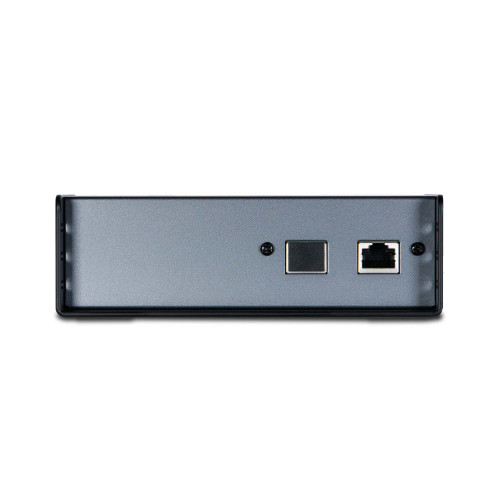
USB and Ethernet connectivity allow the Brick Lane MC4 to communicate with Cranborne Audio's control plugin. Hardware parameters can be controlled remotely from a DAW, while settings and presets can be saved, loaded and recalled.
Key Features
-
4-channel Modal PWM analogue dynamics processor
-
Compression and noise gate processing on each channel
-
Pure analogue PWM signal processing with no digital conversion
-
Mono, Stereo and Mid/Side operation
-
Series dynamics processing
-
Dual-Band analogue compression
-
Dedicated De-Esser mode
-
Six compression modes: VELVET, FLOAT, SMASH, TAME, GLUE and POLISH
-
Cranborne Audio Analogue Lookahead technology
-
Stress control with six mode-specific multi-band analogue saturation circuits
-
ENIGMA advanced compression parameters
-
Variable Attack and Release controls
-
±20 dB Input and Output/Make-up Gain
-
Selectable 60 Hz, 100 Hz and 200 Hz sidechain high-pass filters
-
Four assignable external sidechain inputs
-
Balanced TRS insert send and return on all four channels
-
Integrated Mid/Side encoder and decoder
-
5-inch full-colour TFT display
-
LED encoder rings and digital encoders
-
USB and Ethernet remote control
-
Plugin-based parameter control and recall
-
Preset saving and loading
-
2U 19-inch rackmount format
Technical Specifications
Compression element: Pulse Width Modulation
PWM switching frequency: 250 kHz
Maximum input level: +24 dBu at <0.003% THD
Maximum output level: +26.5 dBu at <0.003% THD
Frequency response: ±0.5 dB, 2 Hz to 80 kHz
Noise floor: < -100 dBu, unweighted
Dynamic range: >118 dB
Line input impedance: 43 kΩ
Line output impedance: 150 Ω
Sidechain HPF: OFF, 60 Hz, 100 Hz or 200 Hz
Minimum standard attack time: 6 ns with 2 µs processing delay
Minimum attack in POLISH with Analogue Lookahead: 6 ns with 0 ns processing delay at 20 kHz
Power supply: Internal mains
Rack format: 19-inch, 2U
Dimensions: 48.3 × 8.9 × 23.6 cm
Unit weight: 6 kg